Awash in NSW
(audio file here)
Maybe it’s the weather — black skies, sodden earth, rain drumming down — but today my thoughts have turned to death. Not in fear, but in reflection.
I’ve been thinking of my near misses at sea, those razor-thin moments between life and death.
Like the night off Japan’s west coast, when a container ship loomed out of the dark — its steel plates sliding past just a metre from our bowsprit. My fault — a captain’s lapse — gazing at the chart below, never imagining a ship would swing toward shore. One did. But we lived.
Another time, in the Tasman near Norfolk, a monster wave reared up taller than our masthead and broke on our foredeck, swamping our ship. Awash, Jude floated off towards the wild sea, holding only a portion of our wooden wheel. Quick action saved her. She always seems to be guiding our craft in moments of disaster, like the North Pacific one winter when a mammoth sea flipped us upside down. Damaged but afloat, 45 days to reach land.
You may think me a careless captain — but I’m not. Jack and Jude never set out to follow the beaten track. We set out to discover Earth, every corner we could.
And why? Earth is a marvel. Peer through the mightiest telescope and you won’t find another like her.
Sailing beneath a star-filled heaven, so dark a shimmer of stars danced upon the sea, making it seem we were travelling through space itself. That’s when thoughts of the creation filled my head. We had this privilege for fifteen years — idle solitude to reflect on mankind’s direction — that’s when I realised our true legacy is not towers of concrete or empires of money, but knowledge, wonder, and our connection to Earth.
I do not believe in the religions of man. I’ve studied most of them. But I do believe in a Creator who placed us here to learn — to witness — and learn to communicate with the creatures that share this Earth with us.
But we’re so busy populating the planet, taking away from the creation, stripping the natural Earth to expand our mega-cities — trading away time surrounded by Nature and we loose sight of the gift. Why? In the world we’re creating, every day we must earn another day’s wage to support our increasingly complex lives.
But there is still the marvel. The dawn and the dusk — the pure, wild breath of Earth — the animals.
So many speak to a pet and see understanding in its eyes. Maybe, if we listen, the animals may yet speak with us.
And so, in this sodden weather, with thoughts of death in the air, I lift my heart in gratitude — For the vast seas, the wild lands, the near misses, the second chances, and for life with my beautiful wife, exploring the natural Earth. And I wish I could convince the youth that humankind is heading in the wrong direction.
The Ship That Never Was –
Australia’s longest-running play, The Ship That Never Was is put on every night in Strahan Tasmania. It tells the dramatic and hilarious true story about the last Great Escape from Sarah Island. It’s a hoot!
But this video is not about the play – Rather, an amazing find we made during the first Macquarie Harbour Clean-up.
SAIL THROUGH HELL’S GATE –
EAST DIAMOND ISLET, CORAL SEA –
FINDING GOULDS TRACK LOST IN SW WILDERNESS –
“Goulds Track SW Wilderness” refers to a historical, overgrown track in the South West Wilderness of Tasmania that was originally used by surveyors and settlers. This track was first established in 1862 by a team led by Tasmania’s first Geological Surveyor, Charles Gould (1834-1893) during their search for gold. Later, the track was used by early settlers. Shortly after WWII, Tasmania Hydro used Goulds Track when surveying for the Gordon-below-Franklin Dam, later abandoned. Hydro marked the track with yellow diamond shaped signs held above the growth on metal stakes. The track is a significant historical route, illustrating the challenges of crossing Tasmania’s wild terrain.
Over five summers, Jack and Jude used their enormous bush skills to search and find the Hydro markers used to mark this historical track as far as the Morrison Camp located on the Gordon River, downstream of the Sprent River. This video documents our camps and search, and walk out from the last ridge before the Morrison’s Camp.
We’ve always wanted to take a packraft overland to that camp, and then float downstream back to Sir John Falls.
Baby Steps to Heaven was the last link. We started from the Morrison Camp on the Gordon River, spent a day finding the start of the thread, then followed it until we reunited with where we left off. Thus completing the entire journey from Sir John Falls to the Morrison Camp along the Goulds Track that was lost to the wilderness after the area was declared a National Park.
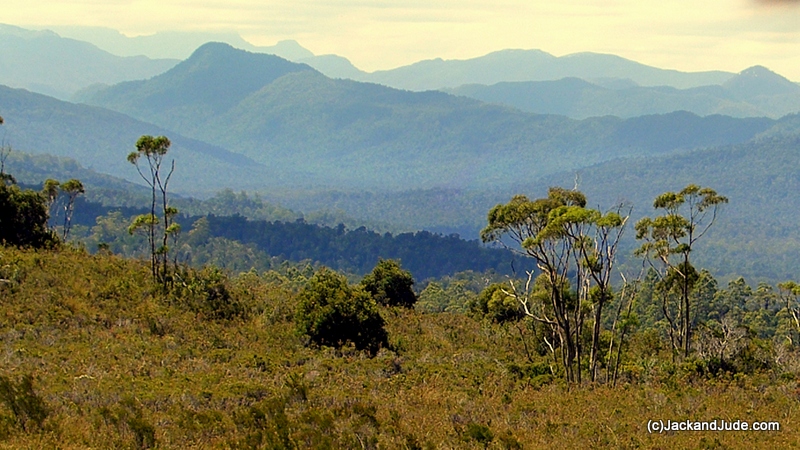
The lovely Franklin Gordon Wild Rivers National Park
AFRICAN HONEYMOON –
We’re sad to report that we’ve not had time to complete the final version of African Honeymoon. Fixing the damage to our house from the 2025 flood has taken all our time. But we’ll be back when the weather warms up.
Any chippie reading this that wants a break to work alongside a river, contact captain.jack@jackandjude.com
Creating African Honeymoon has been a real treat – and a challenge. It’s surreal, writing about an adventure that happened 57 years ago! But what a journey it was. And still is, reliving those precious moments is like sitting down with old friends: Each memory sparks another, and soon we’re astonished by how much we dared—and how much we survived.
We were married at 24 and set off down through Africa in a derelict VW van that we’d rescued from a farmer’s field—completely unaware that over thirty African nations had recently thrown out colonial rule. Borders were fragile. Governments young. Tensions simmered beneath the surface. But we were young and in love. What could possibly go wrong?

Our book African Honeymoon is the first in a trilogy that continues with Around the World and ends with Two’s a Crew.
Here’s a taste from the first draft:
AFRICA
The Oldest Occupied Continent
First labelled the Dark Continent when little was known of its vast interior, Africa is in fact the cradle of humanity. Millions of years before maps gave names to its mysteries, the earliest humans shared Earth’s most spectacular land with the greatest array of wild beasts.
1969 – our third day crossing the open Serengeti Plains in our van
(Kopjes—pronounced “copies”—are ancient rock formations rising from the plains. Some are over 550 million years old.)
Not having seen lions on our first drive around the kopje, I got out to stretch my legs. Judith joined me, and together we explored the main rock, where great slabs had fractured to lay atop its side. Close up, more cracks appeared—and from one, a blue-headed lizard darted out. It froze, turned its head to study us, then bobbed up and down as if saying hello. When it scurried off, we followed—until it disappeared beneath an overhang.
That’s when we saw the male lion looking down on us.
Yes, we got frightened—very frightened. But we figured these animals have plenty to eat, and don’t attack for the pleasure of killing. Only humans do that. So we bowed our heads and greeted him.
Maybe we imagined it—but the king of beasts seemed to acknowledge us. He shook his massive mane and yawned, revealing terrifying rows of teeth—as if to say, I’m feeling lazy. But don’t forget, I could take your head off with one bite.”
Against the odds, we made it to South Africa. A year of dust, mud, breakdowns, and border crossings—yet we got through. But, shaken by apartheid, we soon bought a ticket to Australia—and found the perfect place to live.
Wishing you safe journeys and fond memories,
Enjoyed this story? Stay with us for more!